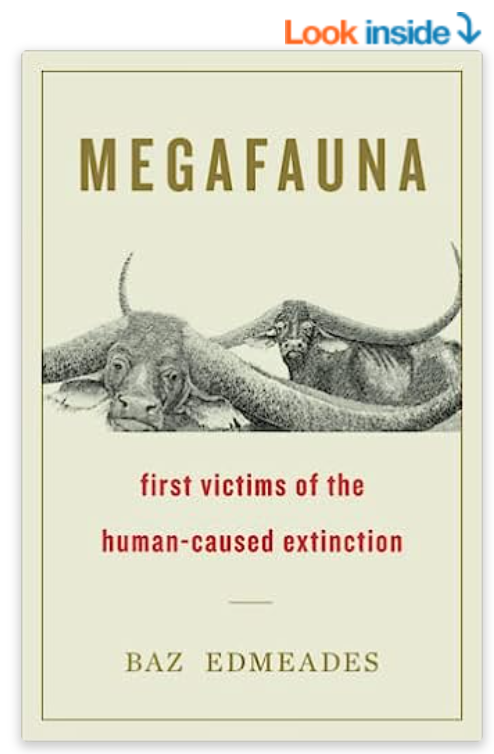
Megafauna —

First Victims of the Human-Caused Extinction
Baz Edmeades
Home Footnotes Author


Part 3

The evolution of to evolve the behavioral defenses against our family hominid inventiveness in Africa was a two-edged sword: it caused the extinction of many of Africa’s largest animals in the earlier parts of the Pleistocene, but it also forced the surviving members of that continent’s megafauna which have enabled a relatively large number of its members to survive into the present.

When Raymond Dart announced in 1925 that he’d identified an ancient, ape-like ancestor of our species in South Africa, his claim was denied, derided and ignored for nearly twenty years. It was only in the late 1940s that the scientific establishment finally acknowledged that the being which Dart had named “Australopithecus africanus” had been a human-like one, situated on or near the line of our species’ ancestry.

Dart didn’t only think that Australopithecus resembled humans on a physical level – he also thought that they had begun resemble us mentally. He argued, as we’ll see in this Part, that Australopithecus had gone a long way toward the “acquisition of articulate speech,” and became convinced that it could use weapons to hunt animals larger than itself. In fleshing out this “they had begun resemble us mentally” scenario, Dart got lots of details wrong: his “australopithecans” almost certainly could not – as he thought they could – make fire. In this and other respects, his intuition had run ahead of the archeological facts available in his lifetime. But that intuition was prescient in other respects, and its guiding assumption – that the relatively close physical resemblance between our species and Australopithecus must, to some degree, have been reflected in the behavior of the latter – has begun to seem more credible since stone tools and butchered bones have been found in association with Australopithecus garhi who we’ll meet in Chapters 9 and 10.

Dart’s two insights – that the human family evolved in Africa, and that hominid ingenuity began to make its appearance relatively early in the evolutionary history of our family – offer an explanation for why the megafauna of Africa (and of south Asia to which African hominids emigrated around 2 million years ago) experienced numerous extinctions early in the Pleistocene. Paradoxically, those insights can also explain, as I argued in Chapter 1, why land-animals as big as elephants and rhinos have survived in Africa and south Asia and nowhere else.

How believable is it that early hominids could have had such a dramatic impact on the megafauna they lived with? With the publication of a 1966 article in Nature, Paul Martin became the first person to put together a reasoned argument that hominids exterminated several kinds of megafauna in Africa in the early part of the Pleistocene. Relatively little was known about the timing of early-Pleistocene events at that time, but Paul was able to marshal enough reliable facts to construct an argument which remains, to this day, persuasive and solid.

Paul returned to this topic in a chapter (“Prehistoric Extinctions: The Global Overview”) in the 1984 Quaternary Extinctions which he edited with Richard Klein, but didn’t publish anything on the subject of the early-Pleistocene extinctions after that date. Until very recently, the late Wilhelm Schüle, whose work we’ll touch on throughout this Part, has been the only other writer to make a case for the proposition that those extinctions had been caused by hominids.

I was satisfied, after reading the writings of Paul Martin (and those of Wilhelm Schüle) on the subject, that hominids had wiped out the megafauna which Africa lost in the early Pleistocene, but the question of how they had done so still niggled. I was fully persuaded that early-Pleistocene hominds had been efficient hunters, but so are cheetahs, and cheetahs have never, as far as anyone knows, exterminated a large number of their prey species. What was the x-factor which made the behavior of early Homo deadly enough to wipe out some of the big animals it preyed on and competed with?

I suspected, as many people do, that it must be connected, in some way, to the intellectual capabilities of our family, but it was only when I discovered the work of the psychologist Leda Cosmides and her co-author, the anthropologist John Tooby that I felt that I might be starting to understand the real power of those capabilities. As we’ll see in this Part, Cosmides and Tooby reasoned that, as soon as hominids became able to construct advantageous new behaviors “ontogenetically,” (i.e. by inventing them), they must have gained an enormous and indeed destructive advantage over prey animals and competitors whose ecological options remained restricted to putting such behaviors together “phylogenetically,” (i.e. evolving them).

* * *

In Chapter 7, which starts this Part off, I describe some of the European and Asian hominid finds which preceded Dart’s discovery of Australopithecus in Africa, and I discuss the Piltdown fraud. “Why the discussion of Piltdown?,” a valued advisor asked me, “Doesn’t that take us too far away from the rise of hominid inventiveness, and its impact on the African megafauna?” My advisor may well be right on that score, but writing a book involves compromises, and I decided, in the end, to retain Chapter 7, because I found that I couldn’t explain the twenty-year failure of the anthropological establishment to accept and acknowledge Dart’s discovery that the human family originated in Africa, without saying something about the fraud that had so much to do with that delay.

As the preceding paragraph might show, I’ve tried, in this Part, not only to tell the story of how our bodies and minds evolved on the African continent, but to describe, in addition, how present-day humans became aware of that this took place. I’ve focused on the growth of that awareness, because I don’t believe it has reached the “mature” or “relatively complete” level that many people assume it has. Anyone who accepts the argument I’ll be making in this Part – viz. that hominids had a profound effect on the megafauna of early- and mid-Pleistocene Africa – will, for example, have to venture well beyond the orthodox belief that the human family’s technological, linguistic and cognitive powers remained, until the last forty thousand years or so, at a rudimentary level.


CHAPTER 7 Pithecanthropus alalus


Creative Commons License
This work is licensed under a Creative Commons Attribution-NonCommercial-NoDerivs 2.5 License.